



Fatih Arslan
It is very difficult to establish communication here, people speak Tetum which is the local language of the country, they also speak Indonesian. I speak with friends who can speak English in addition to Indonesian. We first go the Noor Masjid. This is actually a complex, one part of the complex is used as a school while the other part is used as an orphanage. There are approximately 100 children in the orphanage; some of these children are from the rural parts of the country. They were sent to the orphanage by their families due to absence of a school in their immediate neighborhood and financial problems. The boys stay in the masjid while five or six girls stay in small rooms altogether. There is neither a window nor ventilation in their rooms. We see the kitchen and the cellar of the orphanage which need some tidying. The menu of the day is fixed, rice and vegetable. We provide food for the orphanage which is sufficient for one month’s use. The school is run by the Noor Foundation. The official curriculum in the country is used at the school. There are 1200 students receiving education in the primary, secondary and high school sections. The school is opened to everyone no matter what their religion is.
The masjid is very crowded on the Eid morning. Muslims from various nations join the mass prayer. Following the Eid prayer and offering of Eid wishes to each other, we begin animal sacrifices. We begin distribution of sacrificial meat firstly from the orphans. An orphan shows his belly in the afternoon and says, “I am full.” We become happy. We sacrifice six cattle in Dili.
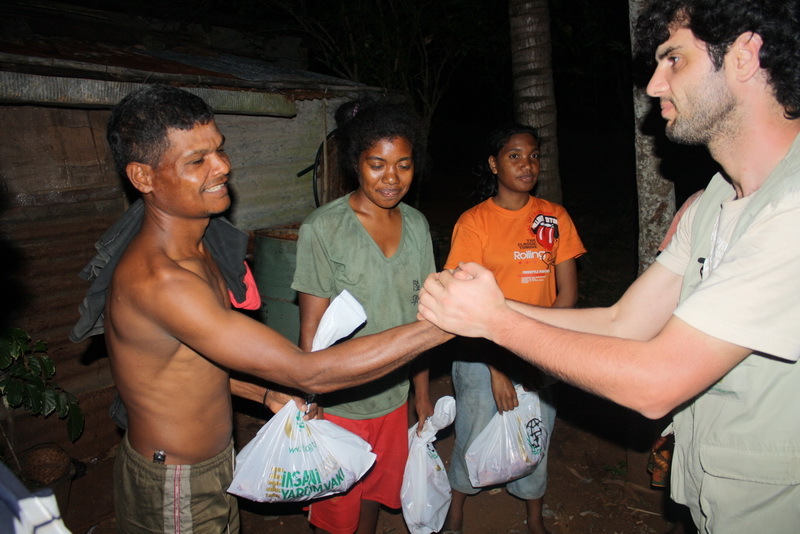
A very long journey is waiting for us. We cover 300 kilometers in six hours. The road is single-lane and there is no alternative to it. If one spends a night here and his automobile breaks down, he has to wait for one day. We arrive at Los Palos, the third largest city of the country at midnight. People show us the way for the city center. Only in the morning, we understand that the city center is comprised of two streets that intersect. We sacrifice animals here and distribute the sacrificial meat. We move for Baucau, the second largest city of the country, in the afternoon. While animals are slaughtered here and sacrificial meat is distributed, we visit the orphanage. This orphanage is in better condition than the one in Dili. The orphanage was maintained by Muslims working at the UN mission. We distribute sacrificial meat to the orphans first and then families in a remote village.
There is a giant statue of Jesus just outside Dili known as the Cristo Rei of Dili. Indonesia which occupied the region in 1975 following a 400-year-long Portuguese colonization, erected this statue in order to diminish international pressure and seem nice to Catholics which constituted 90 percent of the population. After the discovery of oil in Timor Sea, Portugal and Australia immediately looked for ways to abuse its oil resources. There was constant chaos in the country. Following Indonesia’s withdrawal from the country in 1999, East Timor declared its independence. The UN has been in Timor for a decade to ensure security in the country. The tenure of the UN mission is expanded in every two years. Conflicts arise in the country when the tenure of the UN mission is about to end. There is a conflict between the police and the military in the country. Guerillas that revolted against Indonesia which had occupied the country have posts in the military while the police force formed during the Indonesian rule continues to serve. The UN does not only maintain security in the country but it also manages the country’s oil resources.
Australia extracts oil in the country while its revenues are collected by the UN. The UN releases a small amount of the revenues every month. The oil revenues controlled by the UN reached $6 billion in 2010. A new oil site which has been discovered this year has not yet been opened but it is said that the amount of oil in this site is more than that in all the other oil sites. The real cause of all the conflicts in the country is oil. The $6 billion oil revenue of the one-million-population country is sufficient to explain all the turmoil and chaos. There is also coffee cultivation in the country. A famous coffee brand in the world is said to purchase all its coffee from here. The people of the country unfortunately cannot benefit from the revenues gathered from oil and coffee. Five or six most popular supermarkets in Dili are run by Chinese. The supermarkets sell products mainly for those working at the UN mission. In a country where the average national income per capita is $500, an employee at the UN mission spends $500-1000 monthly. The daily economy is dependent on the spending of the UN mission. The literacy rate in the country is 60 percent while there is a high rate of unemployment.
Portugal which stayed in the country for 400 years did nothing for the benefit of the country. Roads, some school and state buildings were constructed by the Indonesian administration. The thing which people said in common in three cities we went to is that the politics is run by Portugal, its economy is run by China, its military affairs are run by Australia and Timorese work as their laborers.