

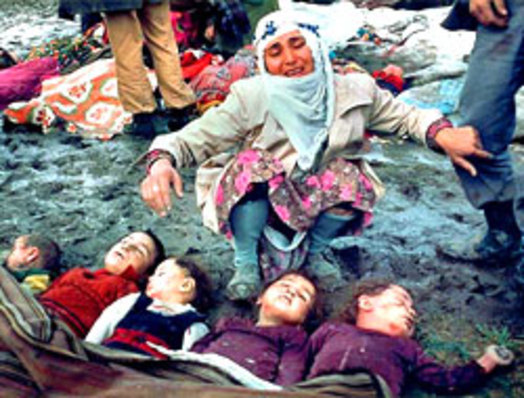
On 16 September 1982, pro-Israeli radical right-wing Christian Phalangist militiamen raided Sabra and Shatila Palestinian refugee camps in southern Beirut, the Lebanese capital, and murdered 3500 people.
By keeping Sabra and Shatila camps under siege, the Israeli army led by Ariel Sharon prevented Palestinians from escaping the camps, which were designated as safe zones by international conventions. The Lebanese Phalangists, on the other hand, did nothing to prevent the Israeli troops from besieging Sabra and Shatila camps housing children, women and elderly people and overlooked the killing of camp residents by pro-Israeli radical right-wing Christian Phalangists.
Sabra and Shatila is only one of the most brutal massacres in the history of humankind. Although the number of the victims is put at 3500, the exact number was not known since most of the bodies were buried in mass graves and severed bodies were lost under the rubbles. Ariel Sharon started to be called “Butcher of Beirut” after commanding the massacre in 1982.
Many sources claim that phosphorus bombs were used in the attacks, while Dr. Amal Shama, who was in the region when the massacre took place, described the attacks as: “I had to put babies into pails of water to save them from flames. When I took them out after half and hour, their bodies were still burning. They continued to burn even at the morgue.”
In an article he published in The Independent, Robert Fisk summarized what he witnessed right after the raid at the camps. “For everyone who stood in the Sabra and Chatila refugee camps in Beirut on 18 September 1982, Sharon’s name is synonymous with butchery; with bloated corpses and disembowelled women and dead babies, with rape and pillage and murder. Even when I walk these streets today after 18 years the ghosts haunt me still. Over there, on the side of the road leading to the Sabra mosque, lay Mr Nouri, 90 years old, grey-bearded, in pyjamas with a small woollen hat still on his head and a stick by his side. I found him on a pile of garbage, on his back, fly-encrusted eyes staring at the blazing sun. Just up the lane, I came across two women sitting upright with their brains blown out, next to a cooking pot and a dead horse. One of the women appeared to have had her stomach slit open. A few metres away, I discovered the first babies, already black with decomposition, scattered across the road like rubbish. The flies racing between the reeking bodies and between dried blood and the hands of watches still ticking on dead wrists. I had to push aside body parts scattered all over the place to climb the small rampart I clambered. Then there was the pretty girl her blood still running from a hole in her back.”
BBC announced that the Israeli Parliamentary Commission which launched an investigation into Sharon’s role in the attacks found him guilty and Sharon resigned as defense minister in 1983.
A judicial inquiry was initiated in Belgium in 2001 when Ariel Sharon was Israel’s prime minister, but it was dropped when a Belgian prosecutor decided that an investigation into the raid committed by Phalangists could not be conducted. On the 29th anniversary of the Sabra and Shatila massacre, the humanity is still waiting for the perpetrators to be held responsible.